 TNK LAB
TNK LAB
TNK LAB
Experience the future of education with TNK LAB. Our cutting-edge simulations and tools empower students to explore complex concepts with intuitive, hands-on control.
Why TNK LAB?
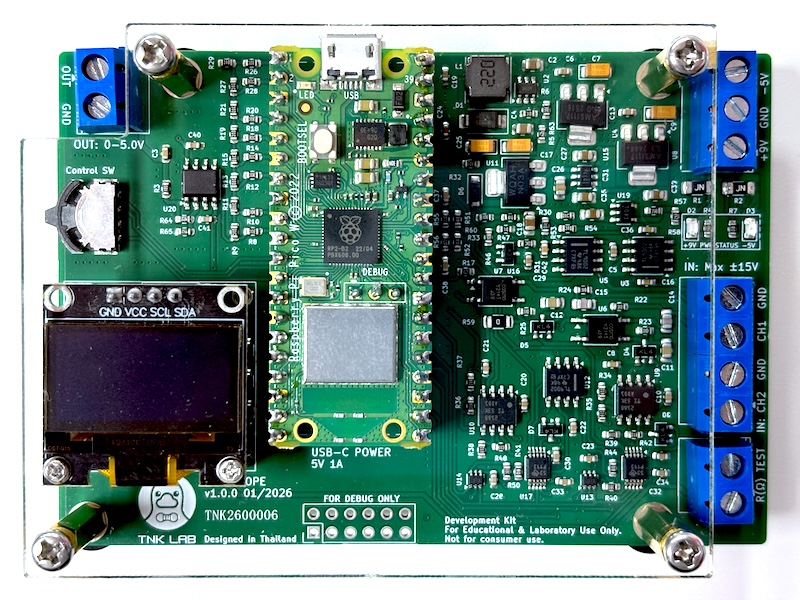
Your compact experimental station for electronics-based physics experiments.
Rugged and classroom-friendly with short protection.
Compact rail-to-rail op-amp board with protection diodes and decoupling capacitors.
Comprehensive guides for physics education.

A complete guide to understanding electronics through hands-on experiments.
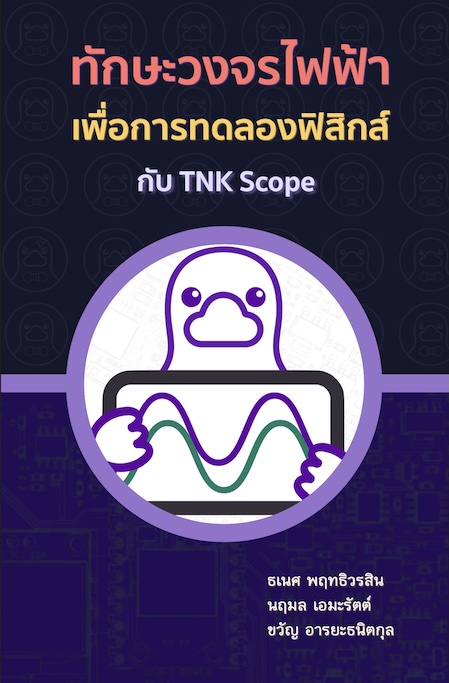
More educational materials and guides are currently in development.
Practical Utilities
A simple yet powerful tool for timing experiments and simulations.
Launch ToolPair your laptops or mobiles with TNK Scope wirelessly for a high-quality 2-ch oscilloscope.
Pair your laptops or mobiles with TNK Scope wirelessly for a high-quality 2-ch oscilloscope.
Interactive Learning Environments
Visualizing 3D rotations has never been easier. Explore pitch, yaw, and roll interactively.
AvailableExplore position, velocity, and acceleration vectors for a satellite in uniform circular motion.
AvailableSee how translation and rotation combine as a wheel rolls, tracing out a cycloid path.
AvailablePick a distribution and sample size, then watch the sampling distribution of the mean become Gaussian.
AvailablePick the degrees of freedom and see the χ² distribution's shape, plus the shaded region for any p-value range.
AvailableSee why a positive test doesn't mean you have the disease — explore prevalence, sensitivity, and specificity with a natural-frequency grid.
AvailableEnter your own x, y data with x- and y-uncertainties, fit a constant, linear, or quadratic model, and read off the chi-square, reduced chi-square, and p-value that tell you whether the fit is actually consistent with your data.
AvailableClick when the light turns green after a random 1–5 second wait, and build up a personal dataset of reaction times — complete with mean, median, standard deviation, and a false-start count for anticipatory clicks.
Available100 particles start packed into one corner of a box and take random steps — watch the gas spread out and entropy climb from nothing but a coin flip with no preferred direction.
AvailableTwo Einstein-solid boxes share a fixed pool of energy quanta through a shared wall — watch the system flow toward the split with the most possible arrangements.
AvailableHeat up N2, CO2, and H2 and watch translational, rotational, and vibrational modes switch on one by one as heat capacity climbs the equipartition ladder.
AvailableApply the same Legendre transform from sim17 to a real thermodynamic potential — swap entropy S for temperature T and watch U(S,V) become the Helmholtz free energy F(T,V).
AvailableLaunch a few "hot" particles into a box at rest and watch every elastic collision spread the initial spike into the equilibrium Maxwell speed distribution — plus a live Shannon entropy trace showing the approach to equilibrium.
AvailableGrow a multiplicity table and bar chart for two solids sharing energy quanta — see why the split with the most microscopic arrangements is overwhelmingly the one you observe, and watch the peak sharpen as N grows.
AvailableSame counting-and-charting treatment as sim20, but for two-state paramagnets sharing a fixed pool of up-spins — includes live spin-array diagrams and a bonus look at negative temperature.
AvailableWatch two paramagnets exchange up-spins via a Metropolis random walk and relax toward equilibrium — including temperature swinging through negative values, something an Einstein solid can never do.
AvailableReproduces Schroeder's classic entropy and temperature curves for a two-state paramagnet exactly — drag through every possible energy and watch temperature go negative past the halfway point.
AvailableCompare the free energy of an ordered vs. disordered paramagnet state as temperature rises — watch the messier state win once TS outgrows the energy gap, the mechanism behind every phase transition.
AvailableHover or click anywhere on interactive phase diagrams for water, CO₂, and nitrogen to read off temperature, pressure, and phase — see why dry ice sublimes instead of melting.
AvailableWatch the van der Waals isotherm grow its characteristic S-shaped loop below the critical temperature — the Maxwell construction finds the real coexistence pressure where liquid and gas share the same Gibbs free energy.
AvailableCombine electronic angular momentum J and nuclear spin I into total angular momentum F, and see the vector-coupling picture behind atomic hyperfine structure.
AvailableWatch a spin precess under a magnetic field and resonate as an oscillating field hits the Larmor frequency — the classical picture behind NMR and ESR.
AvailableCool a trapped gas of bosons in a 3D harmonic trap and watch a macroscopic fraction pile into the ground state below the critical temperature.
AvailableSame trap, same particle number, same temperature — compare how three different quantum statistics predict different populations for each energy level.
AvailableStep through every allowed arrangement of n particles among N single-particle states three ways — bosons, fermions, and distinguishable classical particles — and see exactly why the fermion count is always smallest and the classical count always largest.
AvailableA live, rotatable render of Schroeder's n-space octant — drag the Fermi radius to grow the sphere of filled electron states, then hover or click any mode to read off its energy and watch the discrete count converge to the continuum N formula.
AvailableDrag temperature to reshape the blackbody spectral energy density, plotted against photon energy (eV) with a synced wavenumber (1/nm) axis — compare the Sun, an incandescent bulb, and a blue-white star, and see exactly where the visible band sits relative to each curve's peak.
AvailableNews & Tutorials
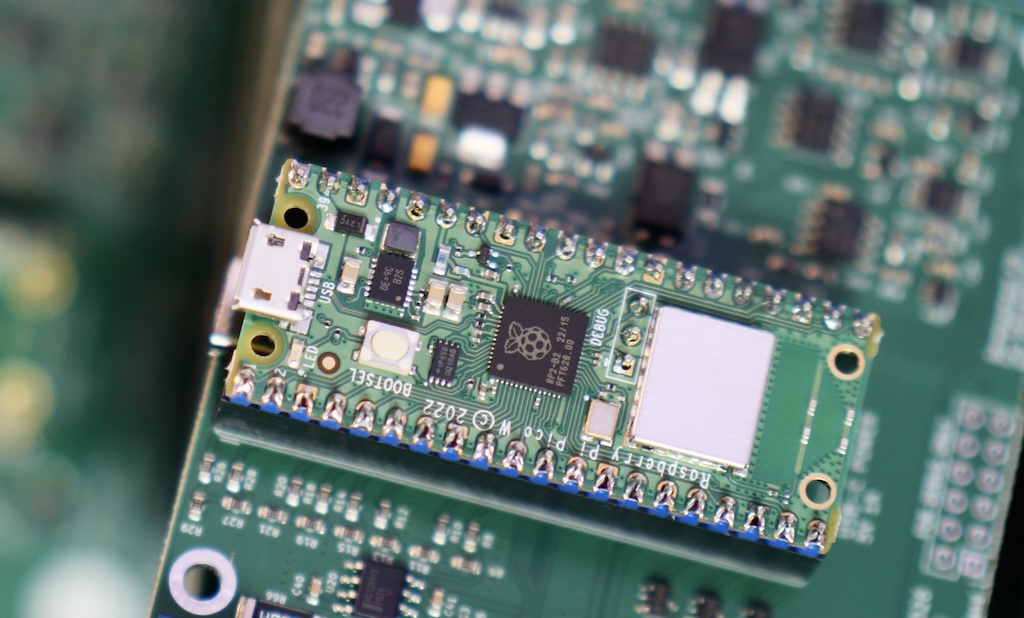
How connecting debug probes to different power sources can cause floating GND failures, and how to fix it.
We are a dedicated team of educators and developers passionate about making learning accessible, interactive, and engaging. Our mission is to bridge the gap between theoretical knowledge and practical application through state-of-the-art simulations.
Contact Us